Updated October 2026 · Reviewed for current Texas market ranges
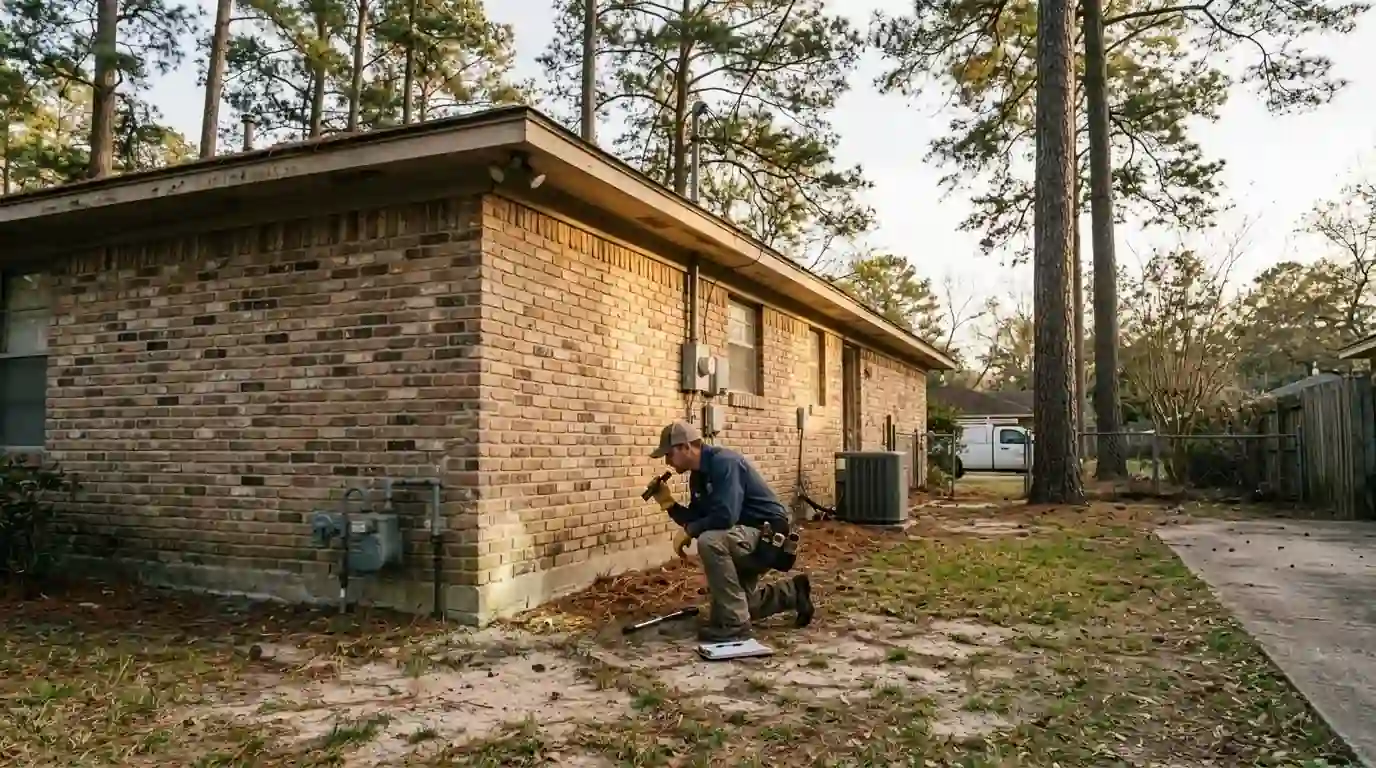
Feral hog trapping near Conroe, TX works best as a short program rather than a single trap: hog sign and travel routes are mapped, a large corral or drop-style trap is placed on the route, the site is pre-baited and watched with a camera until the whole group feeds inside, and then the gate is triggered. Catching only one or two hogs teaches the rest to avoid traps, so patience is the method.
Why hogs need a plan
Catch the whole group, not just one
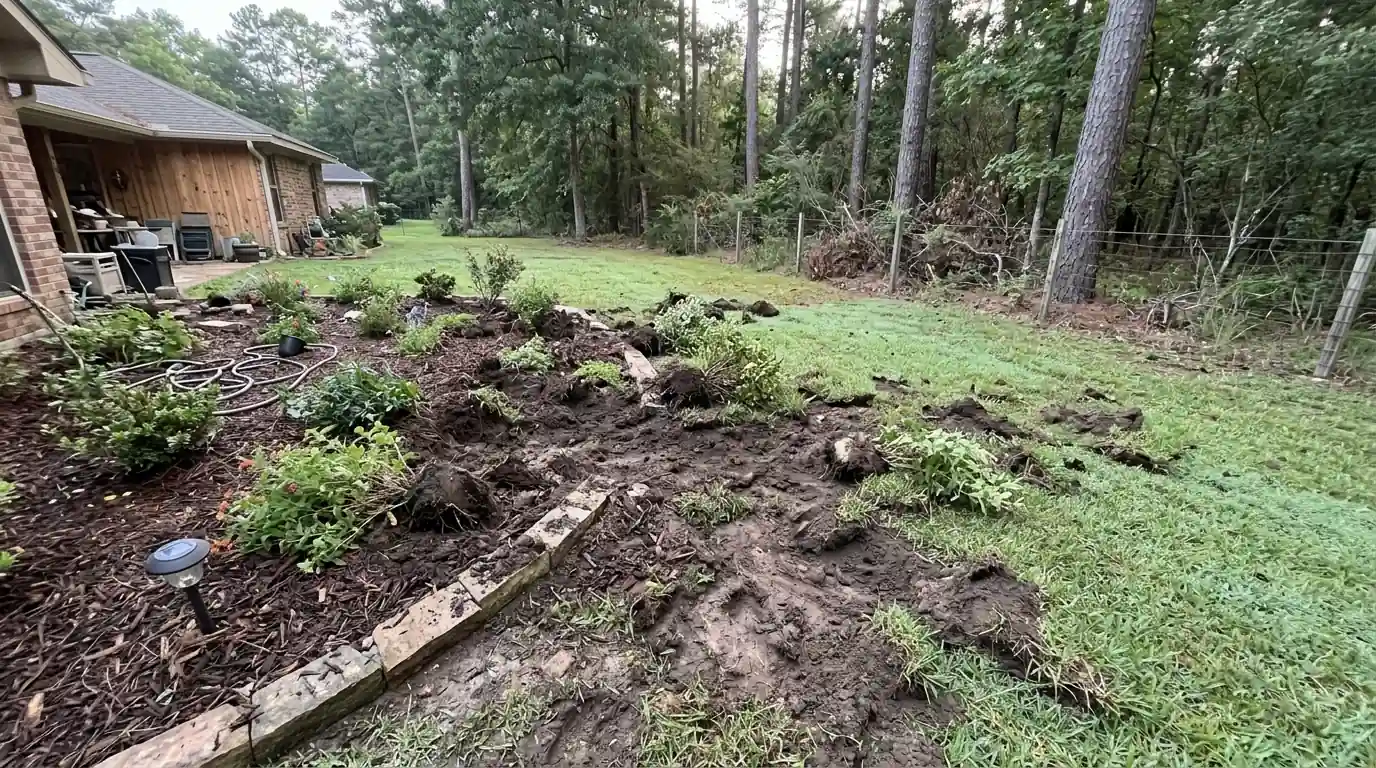
Feral hogs travel in family groups called sounders and feed mostly at night. They root up lawns, gardens and pastures for grubs and roots, wallow in wet areas, and damage fences and landscaping. A single trapped hog warns the others, so trapping is set up to catch the group together.
The work starts with a survey of rooting, wallows, rubs on trees and fence crossings. Traps go on the travel route, and bait is placed for several days before the trap is ever set, with a camera confirming how many hogs are coming in. Only when the whole group is feeding inside is the trap triggered.
Choosing between the options
Choosing a trapping approach
Catches whole groups; best on acreage and larger lots.
Program pricingFits small spaces near homes; catches fewer at a time.
Program pricingProtects specific areas but does not reduce the population.
Quoted separatelyInside the visit
What a trapping program covers
- Rooting and wallow survey
- Fence crossing check
- Trap site selection
- Pre-baiting schedule
- Game camera monitoring
- Daily trap checks
- Feed and grub source notes
- Fencing recommendations
How a trapping program runs
Survey, pre-bait, trap, protect
Corral and box traps
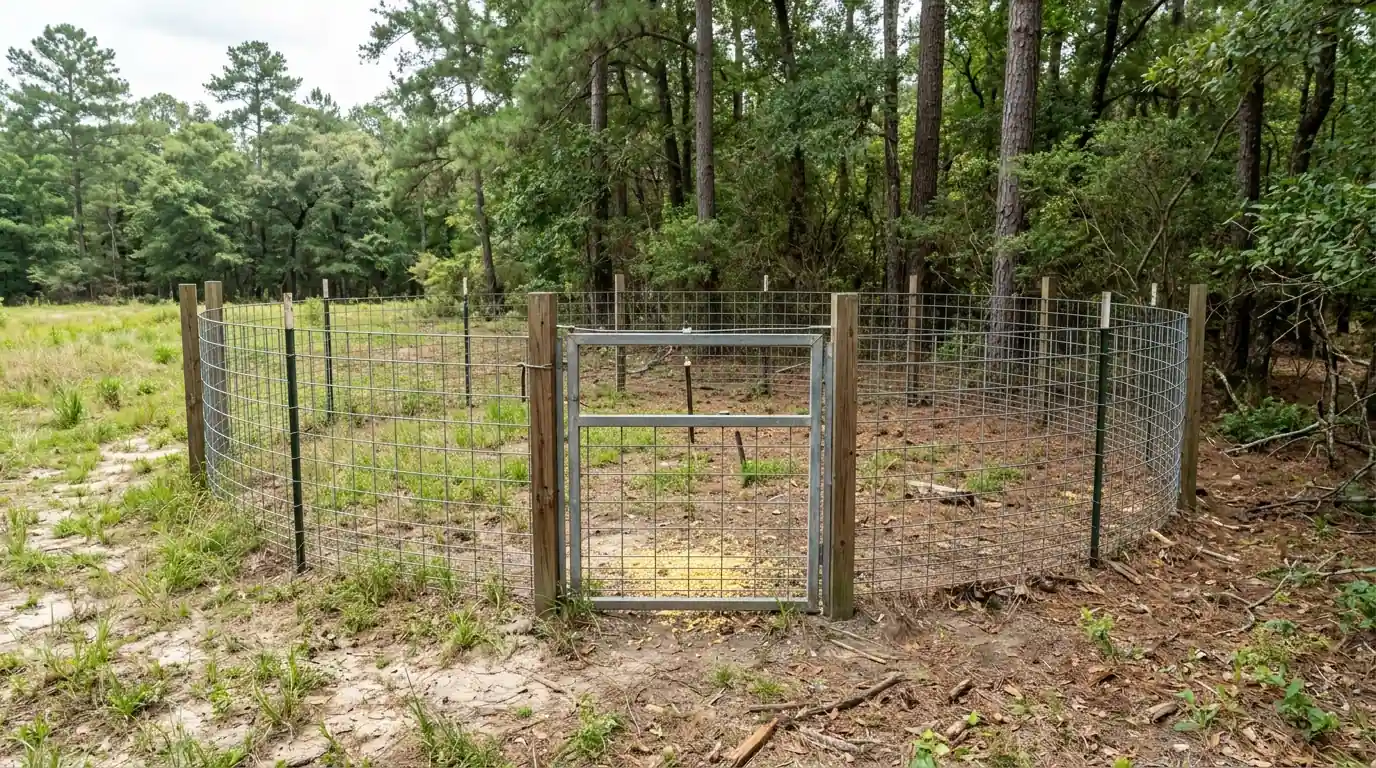
On acreage, large corral traps with wide gates catch whole sounders, and smaller box traps work in tight spaces near homes or along creek edges. Trap type and placement depend on the travel route, the ground and how close the site is to houses, roads and neighbors. Traps are checked daily while set. Placement also considers where stock, pets and children move so nothing else wanders in.
Pre-baiting and monitoring
Pre-baiting conditions the hogs to feed at the trap site before it is armed. A game camera shows how many animals visit and at what time, so the trap is set only when the whole group commits. This step takes the most time and makes the difference between catching one hog and catching the family. Neighbors' camera sightings help when hogs move between several properties.
Protecting the property afterward
After trapping, the visit notes where hogs crossed fences, which wet areas drew them and what attracted them, such as spilled feed or grubs in irrigated turf. Hog-proof fencing at key crossings, removing feed sources and treating lawn grubs reduce how quickly new hogs move back in. Groups that cross several properties are easier to manage when neighbors coordinate, and an HOA-wide program on greenbelts and creek corridors covers ground no single lot can.
What moves the price
What hog trapping costs turn on
Programs are priced by the setup and the length of trapping.
Trap type
Large corral traps cost more to set than box traps.
Program length
Pre-baiting and trapping usually run one to several weeks.
Daily checks
Traps are checked every day while set.
Property size
Larger acreage may need more than one trap site.
Access
Remote or wet ground adds setup time.
Follow-up
Fencing and grub treatment are quoted separately.
Hog trapping is quoted per property after the sign survey, since trap type and program length set the price.
On our Conroe routes
Hogs along the creeks
Feral hogs are not just a rural problem around Conroe. In 2020 Montgomery County Precinct 3 hired a professional wildlife removal company to trap hogs on county property along Spring Creek after neighborhoods reported damage, and Montgomery County Animal Control does not handle feral hogs, so removal falls to landowners and HOAs. Properties along creeks, drainage corridors and wooded acreage see the most activity, especially after dry spells push hogs toward irrigated lawns.
How this job runs
From rooted lawn to a quiet property
- 1
Survey the property
Rooting, wallows, rubs and crossings mapped.
- 2
Place the trap
Corral or box trap set on the travel route.
- 3
Pre-bait and watch
Camera confirms when the whole group feeds.
- 4
Trigger and remove
Trap set once the group commits; checked daily.
- 5
Protect the property
Fencing, feed and grub notes to slow the next group.
Asked about this job
Feral hog questions
County animal control does not handle feral hogs, so removal falls to landowners, HOAs and the companies they hire.
They usually avoid people, but they can be aggressive when cornered or with young. Keep children and pets away from hogs and traps.
Hunting rules, safety near homes and the hogs' habit of scattering make trapping the better choice in neighborhoods and near houses.
Usually one to several weeks, depending on how quickly the group starts feeding at the trap site.
Yes. Programs can be set up for common areas, greenbelts and creek corridors with the HOA's permission.
Jobs that pair with this one
Related work from the same crews
Opossum, Armadillo & Skunk Removal
Armadillos also root up lawns.
Fire Ant Control
Lawn treatments that follow hog damage.
Snake Removal
Other wildlife on the same acreage.
Flea & Tick Treatment
Ticks the hogs carry in.
Plant the flag on it
Woke up to a rooted lawn?
Call and we will survey the property and set up a trapping plan.