Updated October 2026 · Reviewed for current Texas market ranges
Pre-construction termite treatment in Conroe, TX applies termiticide to the prepared soil before concrete is poured: the full pad, beam trenches and plumbing penetrations get treated at the pre-pour stage, then a final perimeter application follows at finish grade. Done in sequence with the builder's schedule, it puts a continuous treated zone exactly where retrofitting one later would mean trenching and drilling a finished home.
Why before beats after
Treating soil you will never see again
Once a slab cures, the soil under it is out of reach forever; every future treatment has to work around that fact with drills and trenches. Pre-treatment is the one chance to put product everywhere termites could rise, under the full pad, down the beam lines, and around every pipe penetration that will eventually offer a hidden path upward.
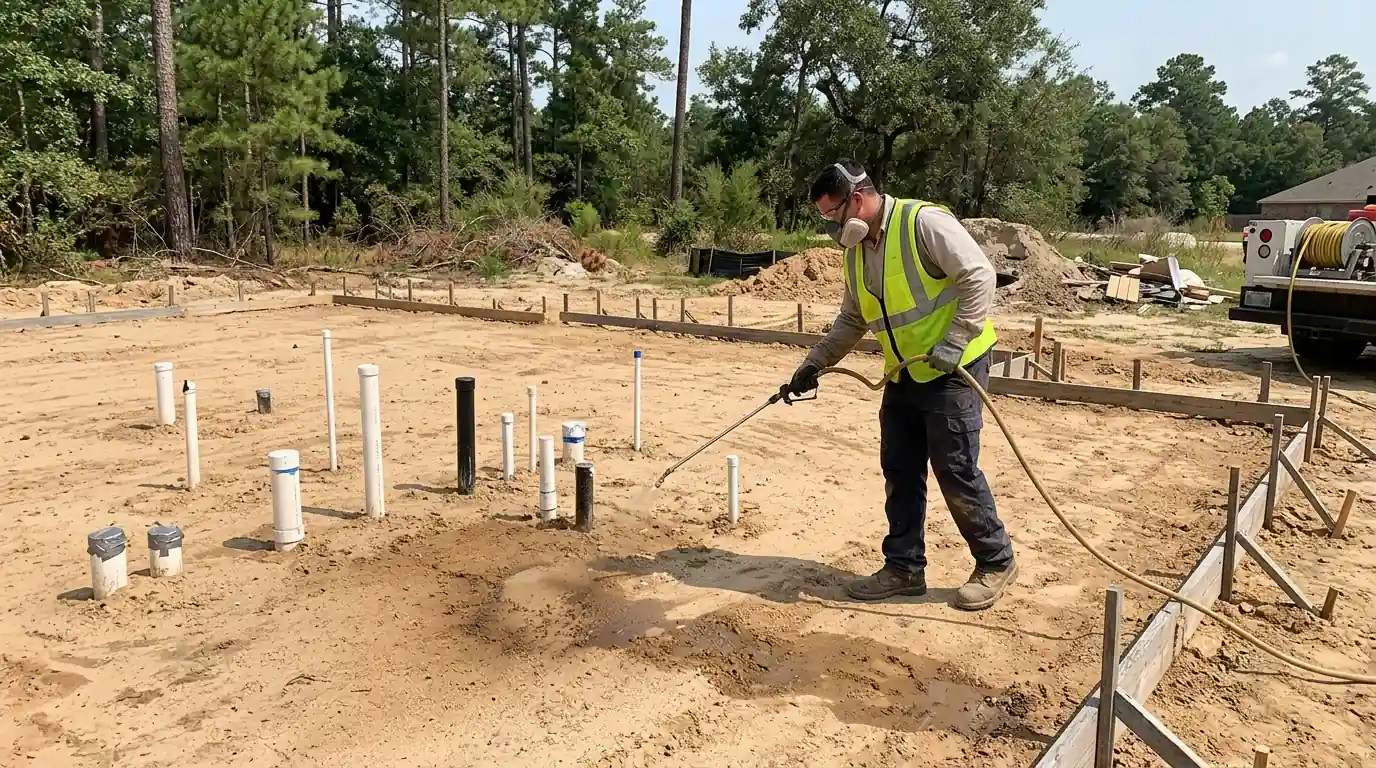
The job runs in stages that mirror the build. The horizontal application covers the pad after plumbing rough-in and before the vapor barrier and pour; vertical applications follow the beams and footings; and the final exterior perimeter goes in after grading, closing the ring. Each stage gets documented because lenders, builders and future buyers ask.
For the builder the appeal is simple economics. Pre-treat pricing scales with pad size and is a line item; the retrofit version of the same protection, drilled through a finished slab, costs multiples and still cannot match under-slab coverage.
Inside the visit
What the service covers, stage by stage
- Full-pad horizontal soil application
- Beam trench and footing concentration
- Plumbing and conduit penetration rings
- Vapor-barrier timing coordination
- Final-grade exterior perimeter pass
- Dated application records for the file
- Multi-lot batch scheduling where wanted
- Re-treat touch-ups if trades disturb treated soil
The three stages
Pad, pour schedule, perimeter
Pad and beam application
The core pre-pour stage: termiticide applied at labeled rates across the prepared pad, concentrated along beam trenches, footings and the plumbing penetrations that become tomorrow's termite highways once concrete hides them. Timing is everything here, after plumbing rough-in but before the vapor barrier and steel make the soil unreachable forever, which is why we schedule to the pour rather than asking the pour to wait on us.
Builder scheduling
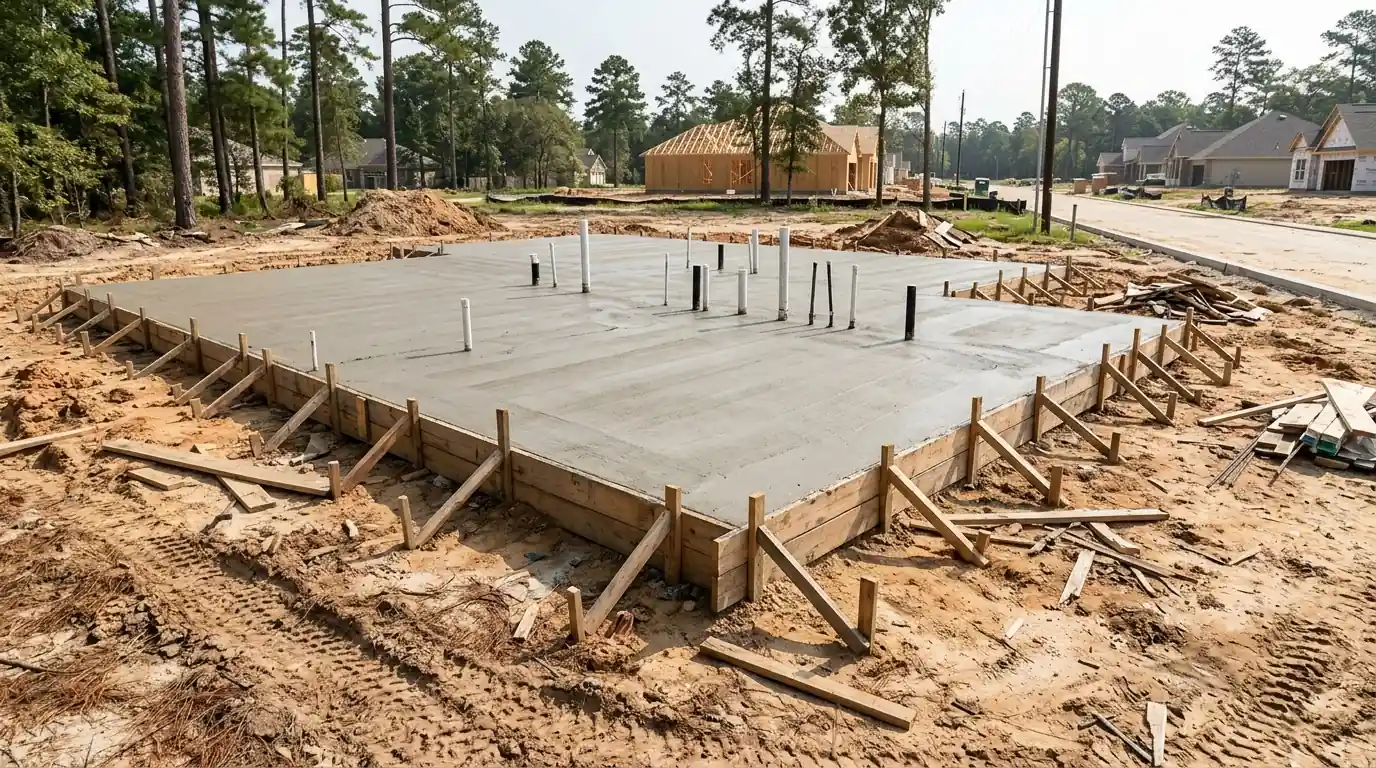
Pours move, and a pre-treat that misses its window either delays concrete or quietly gets skipped, both expensive outcomes. We hold slots against your pour calendar, take the superintendent's reschedules without drama even on short notice, and document each stage with dated photos and application records so the lot file sits closing-ready on the day the finished house eventually sells.
Final grade perimeter
The last pass most people forget: after final grading, a perimeter application ties the under-slab work to the finished soil line, closing the gap that backfill and grade changes open around the cured foundation. The visit is quick, it completes the warranty picture a buyer's inspector will one day ask about, and skipping it undermines everything the earlier stages put under the concrete.
What moves the price
Pre-treat pricing drivers
No published flat range fits every pad, so here is what actually sets the number.
Pad square footage
The horizontal application is priced by the treated area, the biggest single factor.
Beam and footing lineal feet
Post-tension and conventional beam layouts change how much concentrated vertical work the plan needs.
Penetration count
Every plumbing and conduit penetration gets ringed; a complex wet-wall plan adds points.
Phase trips
Pad stage plus final-grade perimeter means two mobilizations, scheduled to the build.
Multi-lot pricing
Builders running several lots on one street get the economics of batched treatment days.
Documentation needs
Lender and warranty paperwork is included; specialty certifications are scoped up front.
Pre-construction work is quoted from the foundation plan rather than a published range; send the slab sheet and the number comes back the same day.
On our Conroe routes
New dirt, old colonies
Conroe is Montgomery County’s fastest-growing city, and every cleared pad disturbs soil that already held fire ant and termite activity; displaced colonies do not vanish, they relocate into the nearest moisture, which is often the fresh construction itself. The subdivision growth running the SH 242 corridor toward The Woodlands and Porter is exactly where we do most of this work, treating pads in phases as builders move lot to lot down the same street.
How this job runs
Slotting into the build
- 1
Send the plan
Slab sheet and target pour date get you a same-day quote.
- 2
Hold the slot
We schedule against the pour and move when the pour moves.
- 3
Treat the pad
Horizontal and beam applications after rough-in, before barrier and steel.
- 4
Document the stage
Dated records and photos for the builder file.
- 5
Close the ring
Final-grade perimeter application once grading is done.
Timeline
Hours of work, years of coverage
A typical residential pad treats in a couple of hours and never holds up a pour that was coordinated in advance; the final-grade perimeter pass is shorter still. The protection itself is measured in years, which is the entire argument for doing it while the soil is open.
Asked about this job
Builder and owner-builder questions
Texas builds handle termite protection through the building standards and warranty expectations builders work under, and soil pre-treatment is the standard way production and custom builders meet it. Practically, lenders and buyers expect the documentation, and the records we provide are written for exactly that file.
Twice. The main application lands after plumbing rough-in and pad prep, before the vapor barrier and steel go down; the perimeter pass comes after final grading. We coordinate with your superintendent so neither visit costs the schedule a day.
Short delays are fine; the application is made for the conditions under a slab. A long exposure with heavy rain or re-grading can disturb the treated layer, and in that case we re-treat the affected areas before the pour rather than letting a compromised layer get sealed in.
Normal weather between treatment and pour is accounted for in how the product binds to soil. What actually compromises a pre-treat is mechanical disturbance, trades trenching through treated beams, which is why we ask to be told about late plumbing changes so touch-ups happen before concrete.
You can protect a finished home with stations or a drilled barrier, and we install both. But neither reaches under the slab the way open-soil treatment does, and both cost more than the pre-treat they replace. The honest framing: pre-treatment is the one option that expires the day concrete arrives.
Yes, batched lot scheduling is most of this service line. One call covers the street's pour calendar, treatment days gang adjacent lots, and each address still gets its own documented record for its own closing file.
Related guide: Early Signs of Termites in Southeast Texas Homes
Jobs that pair with this one
Related work from the same crews
Termite Bait Station Systems
Station protection for homes already standing.
Subterranean Termite Treatment
The retrofit when a slab was never pre-treated.
Termite Inspections & WDI Reports
Documentation for the sale years down the line.
Residential Pest Control
General service once the family moves in.
Plant the flag on it
Got a pour date? That is our deadline too.
Send the slab sheet, name the date, and the quote and the slot come back the same day.